Oven temperature: conversion and gentle heuristics
KitchenScale oven conversion covers cooking dials in °C and °F only—not scientific kelvin tables.
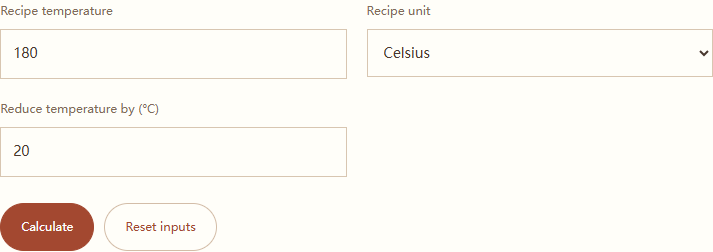
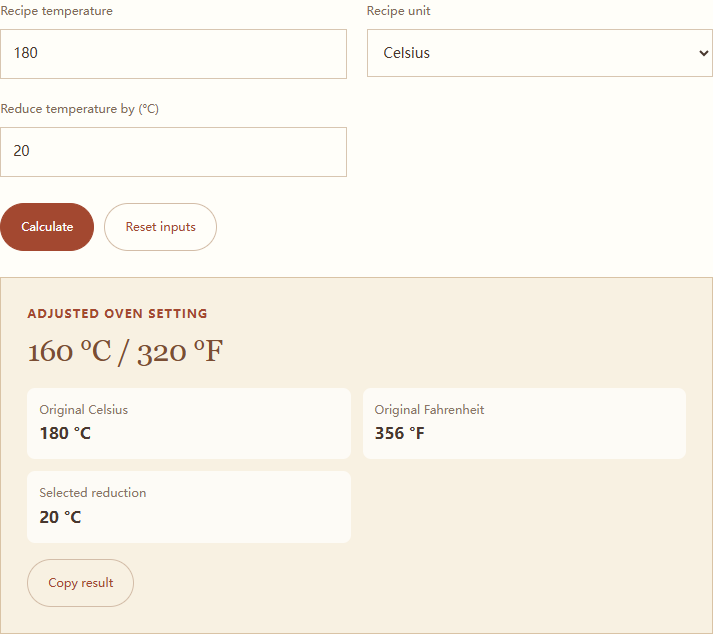
KitchenScale converts oven temperatures between Celsius and Fahrenheit, then optionally applies a reduction you choose. That reduction is a planning heuristic—handy when a recipe assumes a static oven and you are using a fan/convection mode that browns faster—not a law of physics and not a substitute for an oven thermometer. Real ovens drift. Hot spots exist. Food safety and recipe chemistry still outrank a tidy number on a phone screen.
Situations that fit
- Converting an American °F cookie recipe to a metric oven dial marked in °C.
- Trying a modest reduction as a starting point when switching a cake to fan mode.
- Teaching the linear relationship between the two common household scales.
- Checking whether “180 °C” is in the neighborhood of “350 °F” before you preheat.
- Noting a lower trial temperature for delicate meringues or custards you prefer to finish gently.
Heuristics versus physics
Temperature conversion is arithmetic. Fan-assisted browning, steam, rack position, and pan color are physics and kitchen craft. A common home rule is to reduce recipe temperatures somewhat for convection, then check early. Your oven may disagree. Dark pans run hotter at the surface than shiny pans. Glass and ceramic behave differently than thin aluminum. Use the optional reduction as a sticky note, then verify with doneness cues: color, internal temperature where appropriate, and texture.
Worked example
A recipe says 350 °F. Converted, that is about 176.7 °C. If you select a 20 °C reduction for a vigorous fan mode as a first trial, the tool points near 156.7 °C while still showing the dual-unit context. Preheat with an independent thermometer if the bake is expensive. Start checking a few minutes earlier than the recipe’s static-oven time.
Common mistakes
- Assuming every convection oven wants the same offset.
- Ignoring a 15 °C thermometer error in an older appliance.
- Changing temperature without changing expectations for time.
- Broiling on a fan setting meant for gentle bake airflow.
- Treating air-fryer shortcuts as identical to full-size oven behavior.
Limits and disclaimer
Food safety guidelines, recipe structure, and appliance manuals matter more than a single offset. KitchenScale does not convert gas marks on this page and does not certify pasteurization or canning temperatures. When in doubt, measure the oven and the food.
Is the reduction mandatory?
No. It is an optional planning aid. Leave it at zero when you want a pure conversion.
Gas mark?
Not converted here. Use a trusted gas-mark chart from your oven maker if needed.
Air fryers?
Time and airflow differ. Treat translated temperatures as rough and watch the food.
Why not bake by time alone?
Because ovens lie a little and pans change heat transfer. Temperature plus doneness cues beat the clock.
Does altitude change the math?
Altitude can change boiling and baking behavior. This page does not model altitude; adjust with tested high-altitude guidance.