Scaling batter between round pans
Round cake pans invite a clean geometry lesson: area scales with the square of diameter. If two pans are similar in depth and you only change diameter, a useful batter factor is (new diameter ÷ old diameter)². KitchenScale computes that factor so you can move an 8-inch sponge toward a 9-inch tin without guessing. Pan area scaling has limits. Depth changes, batter style, and heat paths still decide overflow risk and bake time. This is kitchen geometry, not a guarantee that a cheesecake will finish in the same minutes.
Situations that fit
- Moving a butter cake from a 20 cm tin to a 24 cm tin for a larger gathering.
- Checking whether a scaled batter volume is likely to crest the rim.
- Adjusting a brownie-style batter when only a different round pan is clean.
- Teaching πr² intuition with something more delicious than a worksheet.
- Comparing two springform sizes before a fragile mousse cake.
Area scaling and its limits
Equal depth is the quiet assumption. If the new pan is shallower, the same area factor can overflow even when the diameter math is perfect. If the new pan is deeper, the cake may sit lower and bake differently. Square and rectangular pans need side-length area math, not diameter. Bundt pans, rings, and novelty shapes need displacement tests or manufacturer volume cups because diameter alone lies. Very large jumps in size can change how heat reaches the center; consider baking as two layers instead of one heroic tin.
Worked example
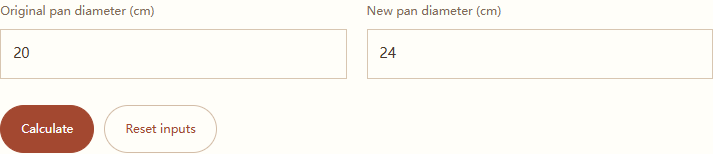
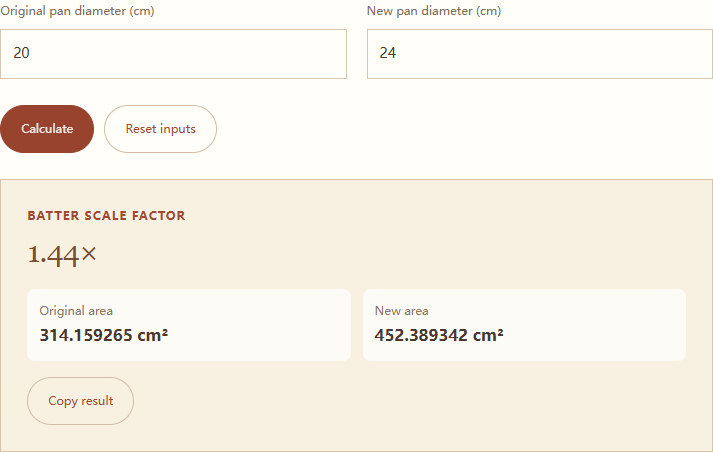
Old pan 20 cm, new pan 24 cm. Ratio = 24 ÷ 20 = 1.2. Area factor = 1.2² = 1.44×. A batter that used 300 g flour becomes about 432 g flour if you scale the whole formula by 1.44. Fill pans only to the height your cake style tolerates—many butter cakes like roughly half to two-thirds full. Begin checking doneness earlier if the new cake is thinner, or later if it is thicker.
Common mistakes
- Ignoring pan depth while multiplying diameters.
- Applying round-pan math to loaves without converting to base area.
- Assuming bake time stays fixed after a 1.4× batter jump.
- Scaling a delicate foam cake the same way as a sturdy butter cake without testing structure.
- Forgetting parchment and release routine changes when the wall height changes.
Limits and disclaimer
The factor does not set the timer, the rack position, or the frosting quantity for tall sides. KitchenScale offers an area-based starting point for round pans. Confirm with visual fill level and doneness tests. When a recipe author prints pan volume in cups or milliliters, prefer that volume comparison.
Square pans?
Compare areas with side² (and account for depth). Do not reuse the diameter formula blindly.
Bundt pans?
Complex shapes need displacement or printed volume, not diameter alone.
Will time stay equal?
Usually not. Thinner cakes finish earlier; deeper cakes need more patience and sometimes a lower temperature.
How full is too full?
Leave headroom for oven spring. If scaled batter exceeds a safe fill line, bake a second smaller pan or trim the batch.
Can I scale frosting the same way?
Surface area of the finished cake does not always match batter area factor, especially for tall versus wide cakes. Adjust frosting by eye after the crumb coat.